|
|
|
| |
| 第一百一十二期:Optical metasurfaces for imaging, sensing and display |
| 信息来源:
发布时间:
2026年03月16日
【大 中 小】 【打印】 【关闭】 |
 |
报告人: |
Prof. Junsuk Rho |
| 报告题目: |
Optical metasurfaces for imaging, sensing and display |
| 报告时间: |
2026年03月06日(周五)15:00 |
| 报告地点: |
西区王大珩厅 |
|
|
| 报告人简介 |
|
Prof. Rho is a Yeon-San (延山) and Mu-Eun-Jae (无垠斋) Endowed Chair Professor at Pohang University of Science and Technology (POSTECH), with joint appointments in Chemical Engineering, Mechanical Engineering, and Electrical Engineering. He received his Ph.D. in Mechanical Engineering from the University of California, Berkeley in 2013. Prior to joining POSTECH, he conducted postdoctoral research at Lawrence Berkeley National Laboratory and served as a principal investigator (Ugo Fano Fellow) at Argonne National Laboratory. He has authored and co-authored over 360 high-impact journal papers, including publications in Science, Nature, Nature Materials, and Nature Nanotechnology. He has been recognized as a Clarivate Highly Cited Researcher (2023–2024) and an Elsevier/Stanford World Top 2% Scientist, and is an Associate Member of the National Academy of Engineering of Korea (NAEK). He serves in 13 editorial positions, including Light: Science & Applications, Microsystems & Nanoengineering, npj Nanophotonics, and Nanophotonics. |
| 报告简介 |
|
Metasurfaces composed of subwavelength nanostructure arrays provide an ultracompact platform for manipulating light with unprecedented flexibility. Optical metalenses have demonstrated imaging performance approaching the diffraction limit and are being explored across a wide spectral range from ultraviolet to near-infrared. These advances enable applications in 3D sensing, LiDAR, VR/AR displays, bio-imaging, and integrated photonic systems.
Despite their versatile functionalities, including tunable focal length and spin-dependent imaging, large-area metasurface design and scalable fabrication remain challenging. To address these limitations, efficient computational approaches such as RCWA and AI-assisted inverse design have been developed. On the manufacturing side, nanoimprint lithography and wafer-scale photolithography offer promising routes toward cost-effective and high-throughput production. These scalable strategies are expected to bridge the gap between laboratory demonstrations and real-world applications. |
| 本期论坛海报 |
|
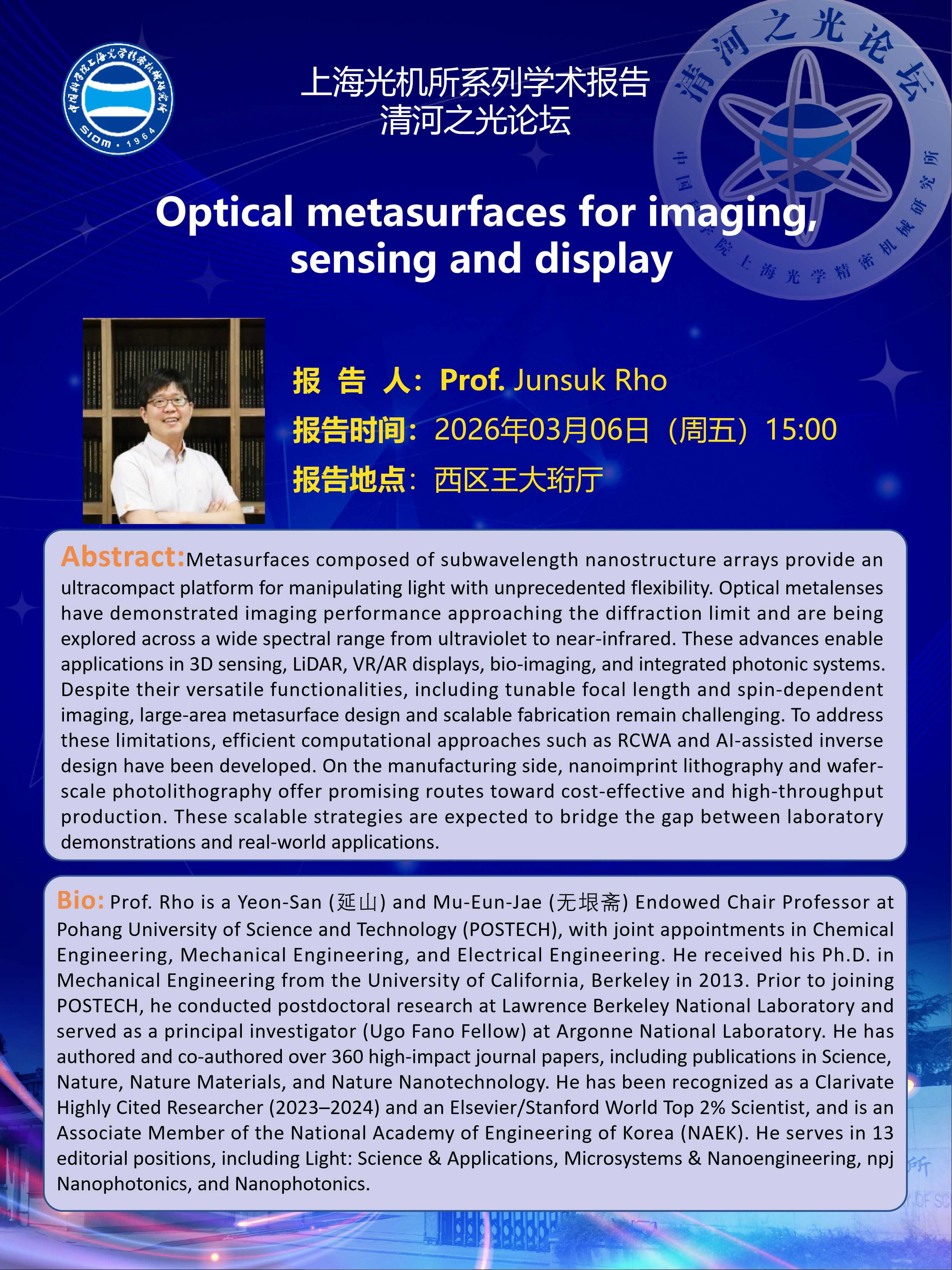
| |
 附件列表: 附件列表: |
|
|
|
|
|
|
|
|